matthew skelly
| about |
| portfolio |
| CV |
| teaching |
| contact |
Matthew Skelly is a visual artist originally from California. His practice is centered around hand-built functional and sculptural ceramic objects adorned with decorative illustrative surfaces.
His work has been featured in exhibitions across the United States and internationally, including the International Ceramics Competition in Mino, Japan and the Taiwan Ceramics Biennale in New Taipei City, Taiwan, both in 2024.
He has received various honors, including the Innovator Award at the 33rd Annual Strictly Functional Pottery National, the Studio Potter Merit Award at the 2025 NCECA Juried Student Exhibition, and the Best in Show Prize at the 2026 Earth & Fire exhibition.
Matthew is currently pursuing a Masters of Fine Arts in Ceramics at Ohio University in Athens, Ohio.
My work is an exploration of ritual, apophenia (the tendency for humans to find false patterns in random noise), and the function of individuals within complex systems. Other topics such as pilgrimage, technological progress, cults, and propaganda also inform the work.
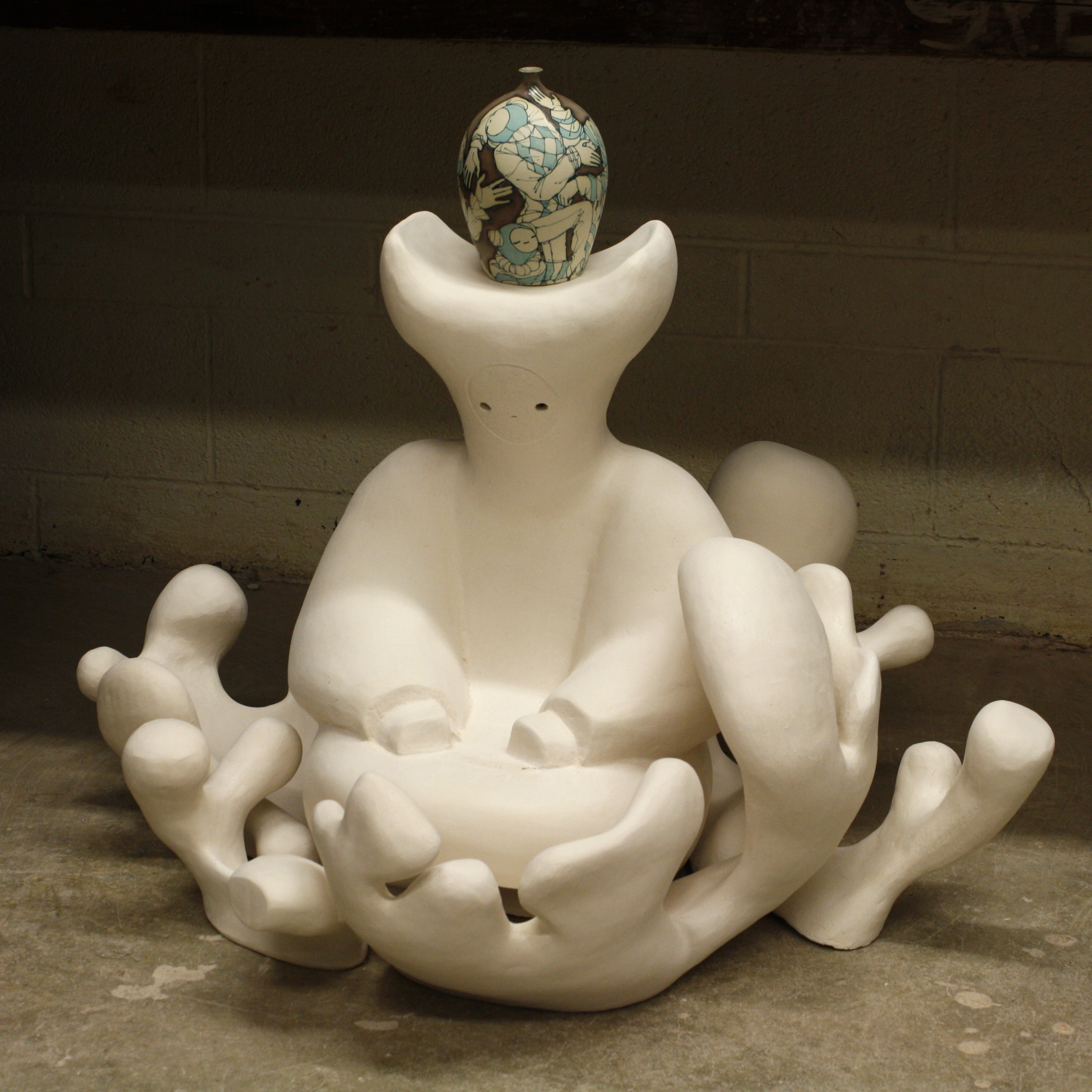
The objects resulting from this exploration, created via hand-building techniques then decorated with underglaze illustrations and a variety of glazes, range from vessels to lanterns, grave markers and ritual tools of clandestine function. This notion of function is generally inextricable from any conversation concerning ceramics, but my particular interest in it lies in the hazy boundary between functional and not, how that boundary changes based on one's status as a member of an exclusive in-group, and how the shift between these states can be utilized as a world-building or story-telling tool.
When not in use, these occult ceremonial objects are designed to stack upon, and nestle within, one another in a variety of arrangements. Upon being stacked, vessels and obscure tools become figures. The surfaces where objects meet and rest are decorated with detailed narrative illustrations, but only glimpses of these drawings can be gleaned from between gaps in each figure's components. As a result, information pertaining to both the narrative illustration and the functionality of each singular object is obfuscated when they are arranged in this way, and can only be observed if the figure is abandoned, deconstructed or scattered into disparate parts.
The notion that humans are programmed to search for patterns is a recurring through-line within my work. At its most innocent, this propensity for erroneous pattern-seeking can manifest as noticing figures in the clouds, a rabbit on the moon, or faces wherever one finds a trio of dots (pareidolia). However, this need to construct significance from something devoid of meaning can lead to illogical, even conspiratorial, methods of rationalization.